
From custom to composable – why digital commerce architecture is shifting rapidly

By Mikko Mantila

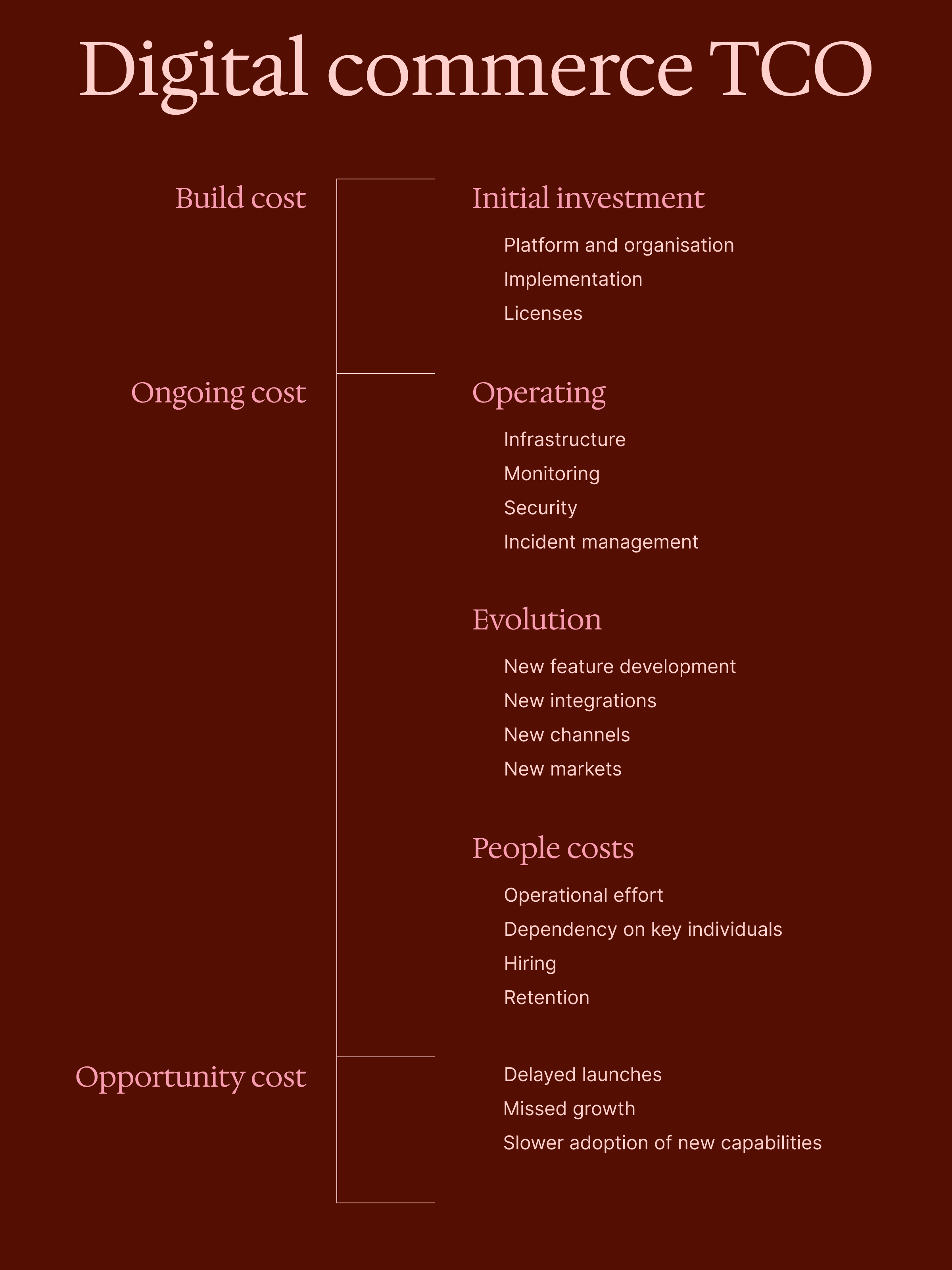
With a healthy TCO trend, costs do not increase at the same pace as the business scales. An organisation should be able to innovate in digital commerce – launching new features, channels and markets – without costs scaling proportionally.
Looking only at spending doesn’t tell the full picture. A more meaningful way to evaluate TCO is to view it as a percentage of total online sales, as this shows whether the platform becomes more efficient as the business grows and complexity increases.
Maintenance takes over innovation
With managed services, you benefit from ongoing security updates, platform improvements and continuous innovation, delivered by the provider. With a fully custom setup, everything lands on your own backlog.
As systems complexity grows, regression testing and compliance work consume increasing amounts of time. Security is a major concern, especially for systems that handle payments. This inevitably pulls resources away from developing new features, improving user experience and driving innovation.
At the same time, ecommerce is evolving rapidly – agentic AI and other capabilities are completely transforming the user experience. In this context, the real cost of a custom stack often lies in lack of flexibility and slow time to value implementing new, transformative features is slow and cumbersome, as each change must first clear security reviews, regression testing and other hygiene factors before it can go live.
With complexity come knowledge loss risks
Custom commerce setups are unique by definition. That uniqueness comes at a price.
Over time, documentation falls behind reality. Technical debt accumulates. Teams develop a reliance on a small number of individuals who understand how the system really works. When those people leave, organisations are left with platforms that are difficult or even risky to operate, let alone evolve.
There are cultural impacts, too. Decision-making slows down as teams avoid changes in an environment of uncertainty. Operational risk becomes harder to quantify, and even routine upgrades start to feel high-stakes. At that point, the system may still run, but it actively constrains the organisation’s ability to evolve.
Summary
Custom commerce stacks have their benefits: they can cater to your exact needs and can, in theory, be slimmed down to only the functionality you require. In practice, three factors come into play:
- TCO is easy to underestimate, with significant costs hidden in salaries and operational overhead.
- Innovation is slow: with custom setups, innovation must compete for resources with hygiene factors, because those basics aren’t handled through shared development across a wider ecosystem.
- Technical debt and knowledge erosion increase risk, making change expensive and uncertain.
Composable transformation does not mean throwing everything away. The most successful transitions are incremental: identifying pain points and replacing those parts with composable services that reduce cost, risk and complexity.
What’s more, build vs. buy is not a binary decision. The right approach is to strategically decide where to leverage off-the-shelf capabilities for scale and speed, and where to invest in building something truly differentiating and specific to your business.
IONA helps companies transition from custom commerce stacks to composable architectures in a pragmatic, step-by-step way. If you’re looking to improve time to value, reduce long-term costs and simplify your technology and operations, let’s talk.
--
Read more about our composable technology offering.