Personalisation that pays: three valuable use cases

Stop losing revenue to fragmented journeys. Most brands already have the data; the gap is activation. Here are three use cases that connect intent signals, customer behaviour and predictive timing to measurable revenue outcomes.
Iiris Takkinen is a marketing automation specialist who has managed CRM ecosystems of over 10 million contacts for global brands including Marimekko, HMD and Amer Sports. Her work sits where data requirements meet creative execution: she builds the segmentation logic and lifecycle triggers, and the campaigns that run on them.
Personalisation is often seen as just a 'nice' extra touch. In reality, it’s a powerful tool that stops you from losing the customers you worked so hard to find. According to McKinsey, personalisation can reduce customer acquisition costs by as much as 50 percent, lift revenues by 5 to 15 percent, and increase marketing ROI by 10 to 30 percent.
Serving every customer the same message in a mass email send is an expensive mistake. To solve it, activate the data you already hold and connect it to the systems that act on it: your CRM, inventory, and loyalty programme.
The 3 foundations of efficient personalisation
1. The engine: data activation
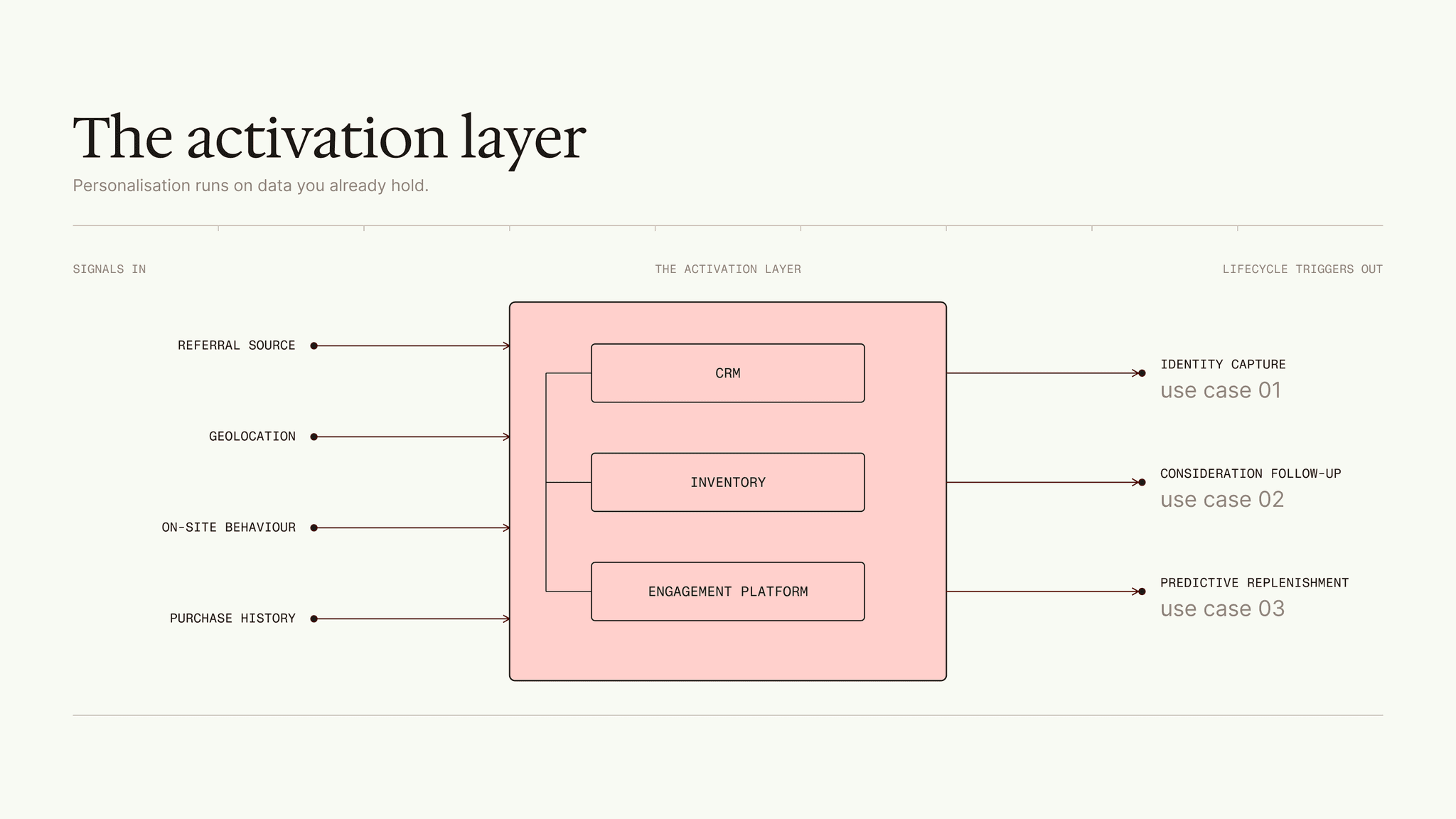
Personalisation is not translated into real sales by buying more software; it's done by activating the data you already hold. To make relevant personalisation in a composable setup, your personalisation layer should talk to your inventory, your CRM, and your loyalty programme simultaneously.
2. The strategy: segmentation and lifecycle management
Effective personalisation requires understanding where each customer is in their journey. By mapping every touchpoint and trigger event across the lifecycle, you can build segments that respond to real behaviour rather than broad demographics. These behaviour-driven segments create communication that arrives at the best possible moment.
3. The multiplier: scaling with predictive AI agents
Once your data and segments are in place, sophisticated customer engagement platforms can use built-in AI decisioning agents to optimise channel, message, creative and timing simultaneously, across every segment, without manual A/B testing for each. Your team sets the rules and guardrails while agents handle the execution at scale.
Three use cases
The three foundations form the infrastructure. The following use cases show what becomes possible when they work together.
Use case 1: Converting the anonymous browser
Key metric: identity capture rate
Up to 95% of website traffic is anonymous. Most brands respond by showing every visitor the same hero banner, the same offer to a first-time arrival as to a returning buyer. That is a missed activation on the majority of your traffic.
Instead, use real-time intent signals like referral source, geolocation, content consumption pattern to trigger dynamic site adjustments. Not every visit needs to be optimised for purchase. Micro-conversions like email sign-up, loyalty programme registration or gated content turn expensive top-of-funnel traffic into owned data you can act on later.
Use case 2: Mastering the consideration phase
Key metric: consideration-phase conversion
Don't wait for the abandoned cart. Target customers while they are still in the consideration phase.
Your customer visited the product page, scrolled to the technical specification, used the comparison tool, then left. Those are high-intent signals you can activate. Personalise follow-up communications with dynamic elements tied to the exact products they investigated. Your brand stays present while they are still deciding, not after they have decided against you.
Use case 3: Re-engaging the lapsing user
Key metric: repurchase frequency
A re-engagement message timed to a fixed interval rather than to product usage data will arrive too early or too late for most recipients. If the product has a 50-day replenishment cycle, you are too early; if it is 10 days you've already lost them.
By activating unified product usage data with historical purchase frequency, you can trigger predictive replenishment journeys. Instead of a generic "we miss you" email, the customer receives a personalised "Refill your routine" message via their preferred channel (SMS, push notification, email) exactly when the data suggests they are running out.
Conclusion: set the KPIs before you build
Each of these use cases produces a signal you can measure: identity capture rate, consideration-phase conversion, repurchase frequency.
Before you activate a single journey, define what success looks like in concrete terms: conversion rate by segment, retention cohort performance, cost per owned contact.
Those numbers are what the system optimises against. Without them, you will see activity, but you will not see results.
You already hold the data these use cases run on. We build the layer that activates it: segmentation, lifecycle triggers, and the integrations that connect CRM, inventory and engagement platform.